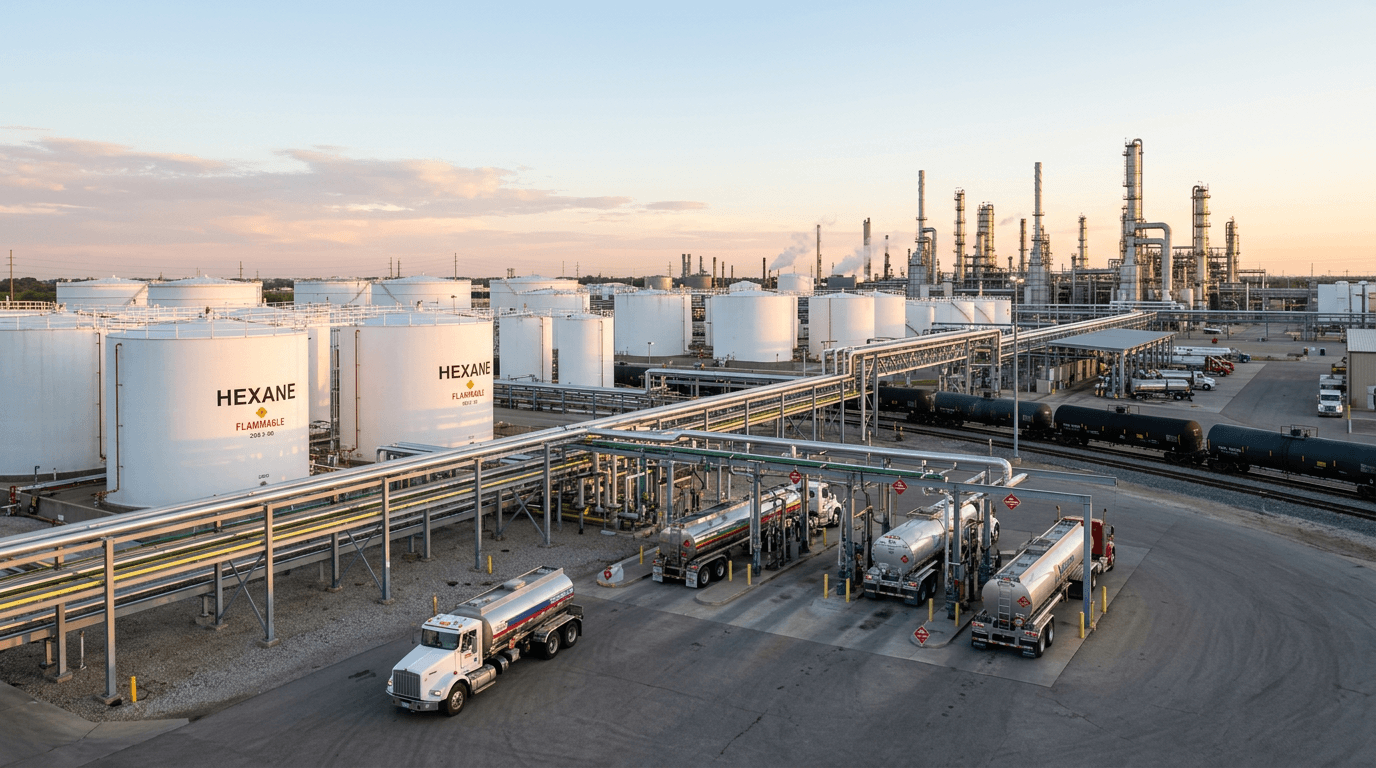
The hexane price decline has become one of the clearest signals of weakness within the petrochemical solvent market in 2026. On June 3, hexane recorded the sharpest single-day price drop among major chemicals tracked in the daily market report, reinforcing concerns about sluggish downstream demand and excess supply across solvent value chains.
For traders, distributors and procurement managers, the movement offers more than a simple pricing update. It provides insight into broader industrial conditions, changing purchasing behavior and the challenges currently facing petrochemical solvent producers. Understanding the forces behind this decline can help buyers make more informed sourcing decisions throughout the remainder of 2026.
What Is Hexane and Why Is It Important?
Hexane is a petroleum-derived hydrocarbon solvent widely used in industrial processing and manufacturing. Its effectiveness as a non-polar solvent makes it valuable across several major industries.
The edible oil industry represents one of the largest consumers of hexane. Manufacturers use it during oil extraction processes to separate vegetable oils from seeds and plant materials efficiently and economically.
The rubber industry also relies on hexane for processing and formulation activities. Producers use it in adhesives, rubber cement and various specialty applications that require strong solvent performance.
Laboratories, research institutions and chemical manufacturers purchase hexane for analytical work and industrial processes. Its chemical properties make it suitable for extraction, purification and testing applications.
Because hexane serves multiple industrial sectors, shifts in demand often reflect broader economic and manufacturing trends. This makes the product an important indicator for market participants monitoring industrial activity.
Global Market Size and Demand in 2026
Global demand for hexane remains substantial despite current market weakness. Large-scale consumption from edible oil processing ensures that the product maintains an important position within the petrochemical solvent market.
However, growth has slowed during 2026. Many industrial sectors have adopted more conservative purchasing strategies due to uncertain economic conditions and uneven manufacturing activity.
The edible oil segment continues to provide stable baseline demand. Food processing remains an essential industry, helping support regular consumption even during periods of economic slowdown.
Industrial demand tells a different story. Many manufacturers have reduced operating rates or delayed inventory replenishment, limiting solvent consumption across several downstream sectors.
The coatings, adhesives and chemical intermediates industries have shown particularly cautious buying behavior. As a result, demand growth has failed to keep pace with available supply.
This imbalance between production capacity and actual consumption has created persistent pressure on solvent pricing throughout the year.
Key Price Drivers and Market Forces Right Now
Several market forces have contributed to the recent hexane price decline.
Weak demand remains the most important factor. Buyers across coatings, intermediates and industrial manufacturing sectors continue purchasing cautiously rather than building large inventories.
Many companies prefer short-term procurement strategies. This approach reduces purchasing volumes and limits opportunities for suppliers to increase prices.
Overcapacity within the petrochemical solvent market has added further pressure. Production capabilities in several regions exceed current demand requirements, creating intense competition among suppliers.
When suppliers compete aggressively for sales, pricing often becomes the primary tool for securing business. This dynamic has contributed to downward pressure not only for hexane but also for several related solvents.
The weakness extends across the broader solvent chain. Products such as acetone, isopropyl alcohol and ethyl acetate have also experienced declining prices, suggesting that the issue stems from broader market conditions rather than product-specific challenges.
Feedstock conditions have also influenced market sentiment. Stable raw material availability has prevented supply shortages from developing, allowing solvent markets to remain adequately supplied.
Together, these factors have created a market environment where sellers compete for limited demand while buyers maintain strong negotiating power.
Top Producing and Exporting Countries
Asia remains the leading production center for hexane and other petrochemical solvents.
China holds a particularly important position due to its large refining and petrochemical infrastructure. Domestic production supports both local consumption and export activity across regional markets.
South Korea ranks among the world's major petrochemical producers. Its integrated refining and chemical manufacturing facilities contribute significant solvent volumes to international trade.
India continues expanding its petrochemical sector and refining capacity. Growing industrial demand and production capabilities have strengthened the country's role in regional chemical markets.
The United States also maintains substantial production capacity. Strong refining infrastructure supports domestic industries while enabling exports to international customers.
Several Middle Eastern countries continue investing in petrochemical expansion projects. Access to competitive hydrocarbon feedstocks supports long-term growth in chemical manufacturing and export activities.
For procurement teams, this diverse supplier base provides sourcing flexibility. However, excess production capacity across major regions has intensified competition and contributed to ongoing pricing pressure.
Applications and Who Buys Hexane?
The edible oil industry remains the largest consumer of hexane globally.
Oil processors depend on hexane extraction technology to maximize yields from soybeans, sunflower seeds, canola and other oil-bearing crops. This application accounts for a significant portion of worldwide demand.
Rubber manufacturers represent another major buyer group. Hexane supports production processes involving adhesives, rubber compounds and specialty formulations.
Chemical manufacturers purchase hexane as a process solvent and intermediate. Numerous industrial applications require reliable solvent performance during production and formulation stages.
Research laboratories and testing facilities consume smaller but consistent volumes. High-purity grades support analytical procedures and scientific investigations.
Adhesive manufacturers also rely on hexane in certain product formulations. Demand from this segment often follows broader trends in construction, packaging and industrial production.
Although these industries create a diverse demand base, current market conditions indicate that several industrial segments continue operating below expected levels. This weakness has limited overall consumption growth.
Risks, Challenges and Regulatory Issues
The primary challenge facing the hexane market involves persistent downstream weakness.
If industrial demand remains soft, producers may continue facing pressure on pricing and profitability. Extended periods of oversupply can discourage investment and reduce operating margins.
Environmental regulations represent another important consideration. Hexane is a volatile organic compound, which means manufacturers and users must comply with increasingly strict environmental and workplace safety standards.
Many companies continue investing in emission control systems and improved handling procedures. These investments help meet regulatory requirements while improving operational safety.
Supply chain management remains a challenge for procurement teams. Maintaining optimal inventory levels becomes difficult when prices continue falling and market direction remains uncertain.
Global economic conditions also present ongoing risks. Industrial production, construction activity and manufacturing investment all influence solvent demand and market performance.
Companies that rely heavily on hexane should monitor both regulatory developments and downstream industry trends to manage risk effectively.
Outlook for the Hexane Market in 2027 and Beyond
The future direction of the hexane market will depend largely on downstream demand recovery.
If manufacturing activity strengthens and coatings, adhesives and chemical intermediate markets regain momentum, solvent demand could improve significantly. Higher consumption would help reduce oversupply and support more balanced market conditions.
The edible oil sector should continue providing stable demand support. Population growth and food consumption trends remain positive long-term drivers for vegetable oil processing.
However, industrial recovery may progress gradually. Many buyers remain cautious about inventory accumulation and capital investment decisions.
Supply-side developments will also play an important role. Producers may adjust operating rates if market weakness persists, helping restore balance between supply and demand.
Broader petrochemical market conditions deserve close attention as well. Because hexane participates in an interconnected solvent chain, changes affecting related products often influence pricing and sentiment.
While short-term pressure may continue, the long-term fundamentals supporting hexane demand remain intact due to its importance across food processing, manufacturing and laboratory applications.
What Buyers Should Do Now
The recent hexane price decline highlights the challenges facing the petrochemical solvent sector in 2026. Weak demand from coatings, intermediates and industrial manufacturing continues to weigh on prices despite stable consumption from essential industries such as edible oil processing.
For procurement teams, the current market environment offers opportunities to negotiate favorable supply agreements and review sourcing strategies. Lower prices may help reduce procurement costs, particularly for buyers with consistent consumption requirements.
At the same time, buyers should avoid focusing solely on short-term price movements. Monitoring downstream demand trends, supplier operating rates and broader petrochemical market developments remains essential for effective procurement planning.
The hexane market provides valuable insight into the health of the wider solvent chain. Its recent performance suggests that industrial demand recovery remains incomplete, even as other chemical segments experience stronger pricing conditions.