


Related Insights

Houthi Embargo Declaration: What It Means for Maritime Law and Chemical Trade Compliance
A recently declared embargo has renewed discussion around international maritime law and commercial shipping risk. Chemical procurement and compliance teams should monitor how legal interpretations could influence logistics, sanctions compliance and global trade operations.

Shipping Risk Overtakes Production Economics as Fertilizer’s Main Price Driver
For the first time in decades, freight costs, insurance premiums and maritime disruptions have eclipsed production economics in shaping global fertilizer prices. This shift signals a new era where logistics economics dictate market dynamics more than crop demand or input costs.
Commodity Chemical Intelligence: The Kpler 34 Framework for Reading Physical Recovery vs Diplomatic Progress
The most important lesson from 124 days of the 2026 Hormuz crisis is that physical supply recovery and diplomatic progress move independently. For chemical procurement teams planning Q3 supply, vessel crossing data from Kpler now matters far more than political statements coming out of Doha negotiations.

MEG After India's Duty Reinstatement: Understanding the New Landed Cost Arithmetic for Polyester Buyers
India's reinstatement of the 5% Basic Customs Duty on MEG imports changes the cost equation for polyester manufacturers and chemical buyers. This article explains the new landed cost arithmetic, why today's costs remain below April's market peak and what procurement teams should monitor in the months ahead.
Top 5 Chemical Intelligence Tools That Proved Their Value During the Hormuz Crisis
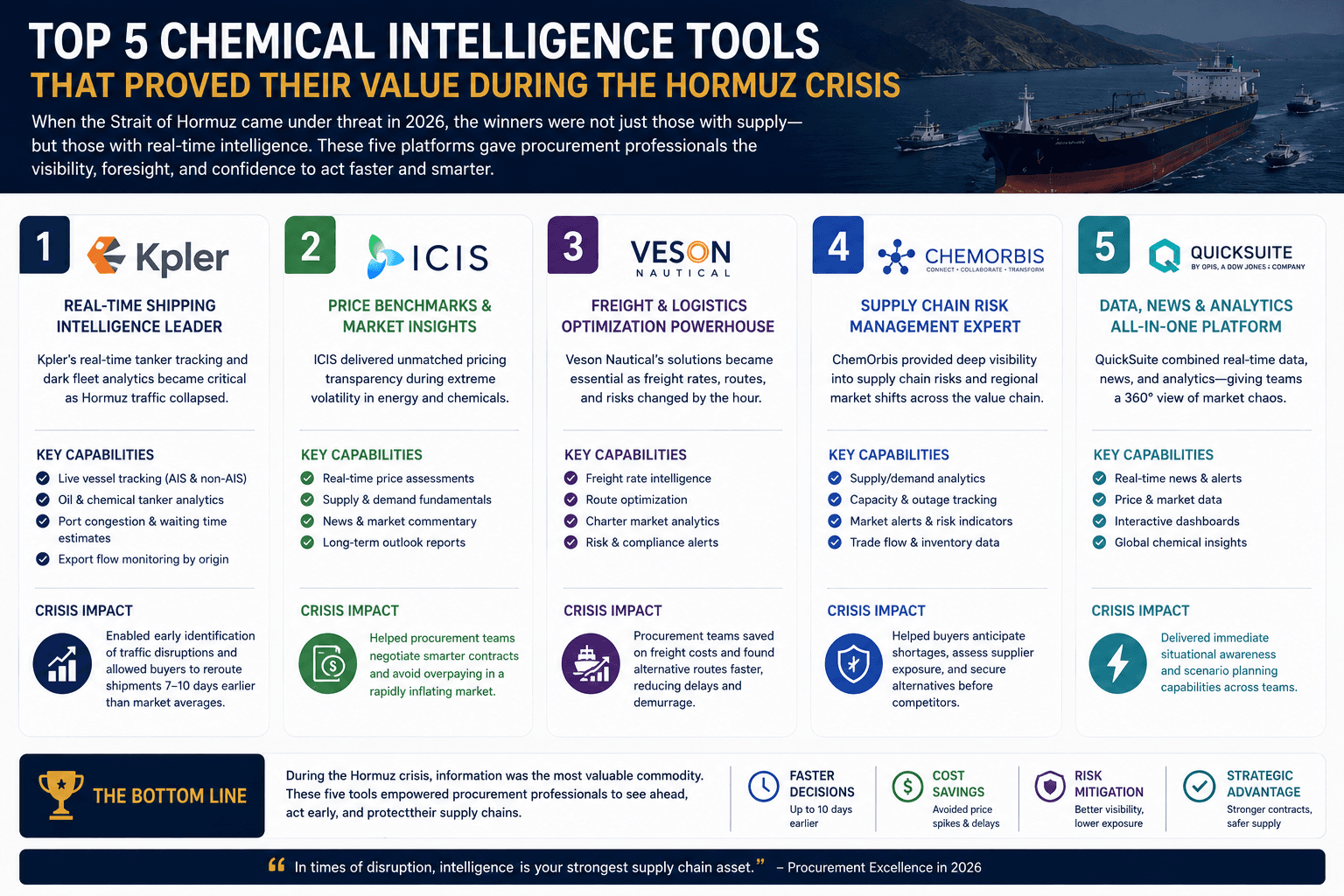
The 2026 Hormuz crisis proved that traditional procurement systems are no longer enough during global supply chain disruption. Tools like Straits.live, ICIS, Xeneta, Kpler, and IMF PortWatch gave chemical buyers the real-time intelligence needed to make faster and smarter procurement decisions when conventional supplier communication failed.

Oman's Maritime Services Negotiation: What a Strait of Hormuz Fee System Could Mean for Chemical Logistics
Oman's proposal for maritime-services charges introduces a very different scenario from a geopolitical transit toll. Chemical buyers and logistics teams should understand how each approach could affect freight costs, compliance obligations and long-term sourcing decisions.
Don't miss out on our updates! Subscribe to our newsletter now
We're committed to your privacy. Tradeasia uses the information you provide to us to contact you about our relevant content, products, and services. For more information, check out our privacy policy.